
The year 2026 represents a pivotal moment for the sustainable global development and education landscape. Building on the outcomes of the 2022 UN Transforming Education Summit, where more than 130 countries committed to rebooting their education systems and elevating education within high-level political dialogue, the international community is increasingly turning its attention toward what comes next. As the world approaches the final stretch of the United Nations 2030 Agenda for Sustainable Development, the Pact for the Future has mandated that the 2027 SDG Summit will kick off official discussions on the post-2030 agenda. In this context, UNESCO is strategically positioning itself to play a central role in shaping the future global education agenda. Chaired by Khaled El-Enany, UNESCO’s Director-General, the SDG 4 High-Level Steering Committee has launched a three-year global consultation process (2026–2028) to define post-2030 education priorities and strategies, with the 2027 Global Education Meeting set to initiate Phase 2 consultations engaging governments, civil society, educators, youth, and other key stakeholders.
At the same time, 2026 will mark a leadership transition with the appointment of a new UN Secretary-General, who will play a defining role in shaping the vision, priorities, and multilateral dynamics of the post-2030 agenda. This process is unfolding in an increasingly fragile context, including rising geopolitical tensions, economic crises, wars, the renewed prioritization of national interests, technological shifts, climate change and societal polarization, which are constraining collective action and weaking international cooperation. Such dynamics are placing growing strain on partnerships, eroding trust between actors, and limiting the space for effective collaboration. At the same time, they risk undermining the foundations for peace by deepening divisions and reducing opportunities for dialogue and mutual understanding.
These challenges underscore the urgent need to reaffirm education’s role as a driver of peace and partnership. Peace, in this sense, is not merely the absence of conflict but a proactive commitment to preventing extremism, strengthening social-emotional learning (SEL), and enabling individuals, including the youth, to translate values of peace into meaningful action. Global Citizenship Education (GCED) – a cornerstone for achieving Sustainable Development Goal 4.7 – offers a critical pathway in this regard. It is a transformative pedagogical approach that integrates peace and partnership by moving beyond formal literacy to cultivate values of mutual respect, empathy, and collective responsibility. In doing so, GCED encourages people of all ages to see themselves as part of a “common humanity” with a shared collective destiny and to engage constructively across differences, naturally fostering more inclusive, tolerant, and cooperative societies.
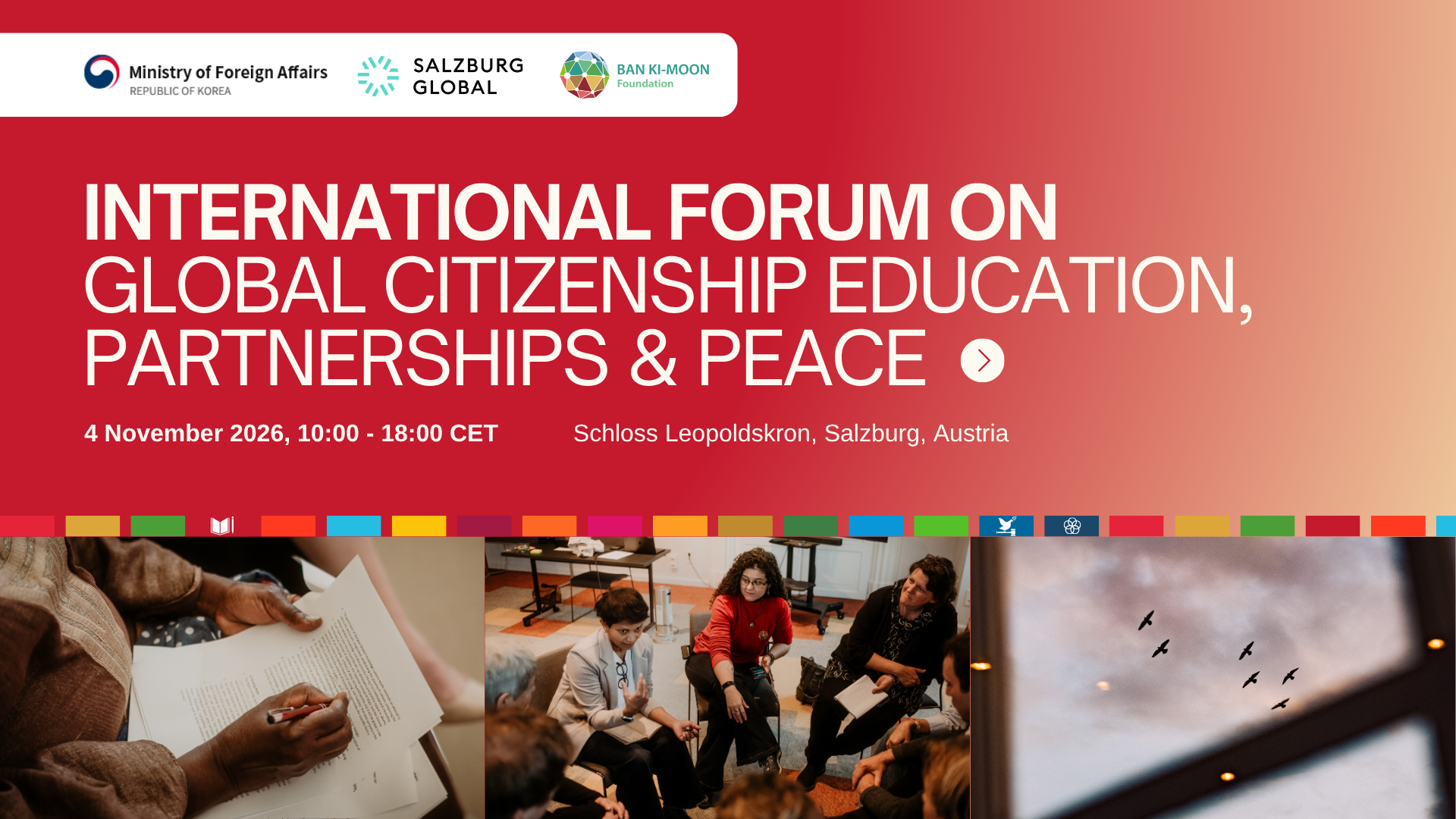
Against this backdrop, the International Forum on Global Citizenship Education, Partnerships and Peace hosted by the Ban Ki-moon Foundation in partnership with the Ministry of Foreign Affairs of the Republic of Korea and Salzburg Global on 4 November 2026 at Schloss Leopoldskron in Salzburg provides a timely platform to foster dialogue, strengthen collaboration across generations and sectors, and contribute to shaping a shared vision for education beyond 2030. In an environment of increased volatility, a sustained focus on partnerships and peace is essential at this year’s Forum, reflecting a growing emphasis on this topic across the international education agenda, including UNESCO’s new approach to Education for Peace, Human Rights and Sustainable Development.