
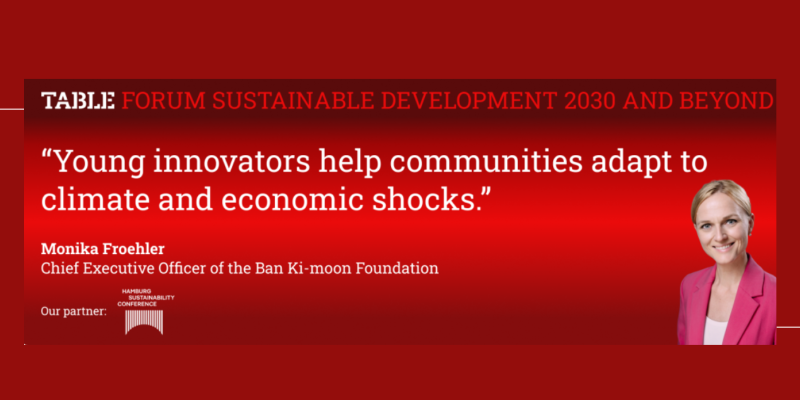
A resilient future depends on young innovators, but only if global finance evolves to back their ideas at scale.
As Agenda 2030’s deadline approaches, the world looks to what comes next. Progress on sustainable development faces threats from the climate crisis, inequality, and geopolitical tensions like the war in Ukraine, conflicts in Middle East, and US-China rivalry. Yet history shows that global cooperation, which is crucial to overcome these challenges, is possible. In 2015, nations adopted both Agenda 2030 and the Paris Climate Agreement, proving their commitment to collective action.
The Post-2030 Agenda debate offers a chance to renew that ambition. At its core must be youth, whose leadership, ideas, and energy are vital to shaping lasting change that can be carried into the future.
The Power of Youth Post-2030
Young people are already spearheading the drive towards a climate-resilient and sustainable future. Many are developing innovative solutions to the world’s most pressing sustainability challenges. However, systematic barriers stand in their way.
Current development finance fails to effectively support youth-led initiatives, deeming them too small or structurally unready. Youth access to major climate finance mechanisms, including the Adaptation Fund and Green Climate Fund, remains constrained and far from mainstream, especially for the most vulnerable working in areas such as smallholder farming. Funding is often short-term and directed towards larger entities, making it difficult for young innovators to scale promising solutions.
Yet, given the right support, youth consistently demonstrate impact. At the Ban Ki-moon Foundation (BKMF), we back innovators like Smart Israel, whose Smartel AI systems monitors real-time pest and disease threats to crops in Nigeria and Rwanda, boosting yields by up to 300%. Similarly, another BKMF changemaker, Ifeoluwa Olatayo, uses geospatial data via her Farmslate enterprise to expand financial access by creating risk profiles for smallholder farmers in Nigeria while promoting climate-resilient agriculture. It is this forward-thinking attitude, embodied by young innovators, that helps communities adapt to climate and economic shocks, sparking society-wide solutions.
This shows what is possible when youth-led innovations are properly supported. The challenge is ensuring that such support becomes the norm rather than the exception.
What Comes next?
With only three years left for Agenda 2030, progress is stalling in many areas. As world leaders prepare to debate about a Post-2030 Agenda, we must outline an ambitious vision that will put young innovators and their financing at the vanguard. Drawing on Andrew Sherriff and ECDPM’s analysis, three broad scenarios emerge when looking beyond 2030.
The first scenario is a prolongation of the existing SDG Agenda, where current systems remain largely unchanged. While this may deliver incremental progress, many structural barriers, including those facing young innovators, would persist.
The second is fragmentation of the Global Goals. Weakening multilateral cooperation, coalitions of the willing and a retreat from universality yield a more decentralised, uneven development landscape. Progress would likely concentrate in lower-risk and wealthier regions reducing opportunities even further for sustainable, strategic youth-led innovation, particularly in the Global South.
The third should be transformative: an ambitious new set of goals replacing the SDGs. While politically ambitious, it offers the greatest potential to address global challenges at scale. It would reshape development finance, governance and implementation to empower youth as key drivers of resilience, innovation and long-term impact. However, geopolitical headwinds and economic realities risk derailing this process at the younger generation’s expense.
Investing in the Future
Young people face these challenges firsthand and yet possess the digital expertise, local knowledge and long-term vision needed to drive meaningful progress. As world leaders debate a Post-2030 Agenda, they must reshape development financing to support youth innovation and unlock the potential of a generation ready to deliver lasting change.
Author: Monika Froehler is Chief Executive Officer of the Ban Ki-moon Foundation which aims to foster leadership for the implementation of the Sustainable Development Goals and the Paris Climate Agreement.
Our Partner: Hamburg Sustainability Conference