
For the first time, the Ban Ki-moon Foundation attended the International Monetary Fund (IMF) and World Bank (WB)’s Annual Meetings from October 13 to 16, 2026 in Bangkok, Thailand. Monika Froehler (CEO) and Roxanne Chao (Project & Partnership Officer) engaged with policy leaders, scientists, and actors from international financial institutions (IFIs) and multilateral development banks (MDBs) to discuss the crucial need to invest in climate-resilient food systems. When food systems are increasingly under strain by climate shocks like El Niño or geopolitical tensions, the consequences go beyond agriculture, affecting food prices, nutrition, health, education, and livelihoods. This was top of mind for the BKMF team going into this conference, where it became evident that food security is a fiscal, economic and social issue as much as an agricultural one. As Nigel Clarke (Deputy Managing Director of the IMF) put it in his speech at the IMF’s “Food Security in an Age of Shocks” event, “If you don’t feel it, you don’t know it”. Institutions need to listen and approach this work with humility, prioritizing action that reaches the most vulnerable.
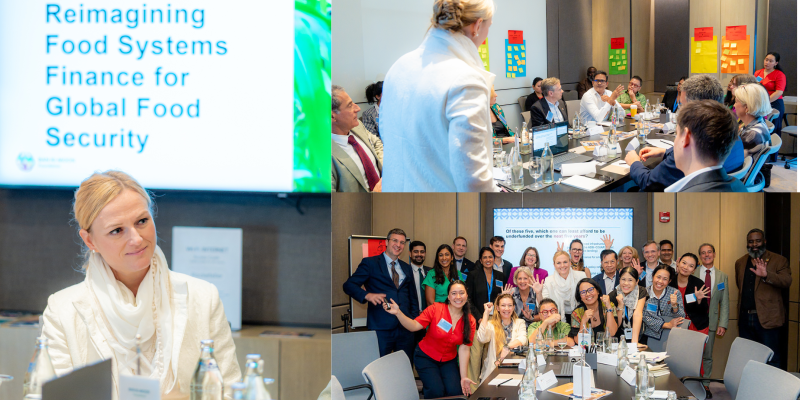
In addition to the IMF-WB Meetings, the BKMF team had the pleasure of also attending the Rockefeller Foundation’s Asia XChange 2026, hosted on the sidelines of the Annual Meetings. Titled “Beyond the SDGs: Reimagining Food Systems Finance for Global Food Security”, the BKMF leveraged its convener powers to host an intimate, invite-only roundtable that brought together actors from governments, MDBs, IFIs, philanthropy, research, and the private sector to explore how to close the financing gap for sustainable food systems that reach smallholder farmers. We were honored that Rockefeller Foundation’s Sara Farley (Regenerative School Meals Co-Lead and Vice President for the Food Team) and Beverley Postma (Executive Director of Grow Asia) opened the session with framing remarks. Through workshop style case activities, including a fictional case study of a smallholder rice farmer, participants grappled with a critical question: Where should the next dollar go to make the greatest difference for those working closest to the challenges? The consensus of the room was the money exists; the problem that remains is the missing architecture to deliver it where it’s needed most. Through discussions, it became evident that closing the gap between innovation, finance, and the farm is essential to create lasting opportunities and shaping a more sustainable future for future generations.
In addition to hosting the roundtable event, the BKMF participated in several other events in the Asia XChange program. Notable from this list was a roundtable, titled “Global Think Tank Cooperation for Inclusive Development”, where Monika Froehler (CEO) spoke about elevating climate adaptation in agriculture and emphasized the important role agricultural research and development has in transforming food systems.
The BKMF went home with one message in mind: waiting is the expensive choice. We must engage all sectors and work across silos to deliver action that reaches those who face food insecurity, support smallholder farmers in safeguarding their livelihoods, and ensure we protect the planet in building sustainable and nature-positive food systems.