
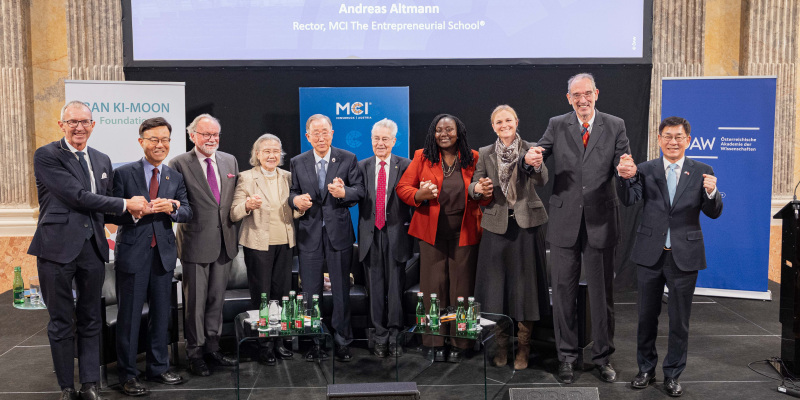
From 22 to 23 October 2026, BKMF Co-chair Ban Ki-moon visited Vienna for a series of high-level engagements, including the SDG Dialogforum 2026, a lecture for the Management Center Innsbruck (MCI), and an event at the Vienna School of International Studies. The visit focused on the future of multilateralism, the importance of international cooperation, and advancing the Sustainable Development Agenda towards 2030 and beyond.
On the evening of 22 October, Co-chair Ban Ki-moon and BKMF CEO Monika Froehler met with Monica Juma, Director-General of the United Nations Office at Vienna (UNOV) and Executive Director of the United Nations Office on Drugs and Crime (UNODC). Their discussion focused on the work of the United Nations in Vienna and ongoing international efforts to combat organized crime, highlighting the importance of multilateral cooperation in addressing global security challenges.
On 23 October, the BKMF, together with the Vienna School of International Studies organized the “The State of the World” Symposium, bringing together more than 160 participants to explore the role of multilateralism, political leadership and international cooperation in addressing today’s complex global challenges such as the climate crisis.
In particular, they spoke about the race for the next United Nations Secretary-General at the end of this year. Another key topic was the need to invest in more resilient food systems, as agriculture faces increasing pressure from extreme weather events, water scarcity and changing climatic conditions. The engagements also offered the next generation of diplomats a valuable opportunity to exchange perspectives and take part in forward-looking discussions on the future of international relations.
In his keynote, Co-chair Ban Ki-moon called upon the young diplomats: „The future of international cooperation will depend on people like you. You will inherit a difficult world. But you will also inherit the opportunity to shape it. Do not lose faith in the possibility of cooperation. Because our world does not need fewer bridges. It needs more. And building those bridges, between countries, between cultures, between generations and between people will be one of the defining responsibilities of your generation.“
The subsequent panel discussion featured BKMF Co-chairs Ban Ki-moon and Heinz Fischer, Professor of International Studies Holger Hestermeyer, and Student Representative Adel Mussabekova. Moderated by BKMF CEO Monika Froehler, the discussion highlighted a central message: Political leaders must demonstrate global vision and commitment, while governments, international organizations, civil society, the private sector and young people must work together to rebuild trust, strengthen international cooperation and advance peace and stability.
During the interactive Q&A session, students raised pressing questions about current geopolitical deadlocks, the recurring paralysis of the UN Security Council and the financial challenges facing the United Nations system. The exchange reflected the strong interest of the next generation in the future of multilateralism and the effectiveness of global institutions such as the United Nations.
BKMF Co-chair Ban Ki-moon was also delighted to meet the newly appointed Ambassador of the State of Kuwait to Austria and the International Organizations in Vienna, Fawaz Bourisly. The occasion provided a valuable opportunity to exchange updates on the Foundation’s latest developments and reaffirm the longstanding partnership between the BKMF and the State of Kuwait.
Later that afternoon, Co-chair Ban Ki-moon delivered a lecture entitled “Climate Crisis & Global Citizenship” as part of the MCI Distinguished Guest Lecture Series.
Held at the Grand Ceremonial Hall of the Austrian Academy of Sciences in Vienna, the event addressed the global challenges posed by climate change, the importance of global citizenship and shared responsibility, and the vital role of young people in shaping a sustainable future.
The event was opened by Co-chair Heinz Fischer, alongside Rector of MCI Andreas Altmann, President of the Austrian Academy of Sciences, Heinz Faßmann, and Ambassador of the Republic of Korea to Austria and BKMF Board Member, Ham Sang-wook,
In Co-chair Heinz Fischer’s opening remarks, he highlighted the importance of sustained collective commitment, drawing a parallel between safeguarding democratic values and addressing the climate crisis: “History has taught us that democratic institutions and freedoms, once established, are quite stable, but they are not guaranteed forever. They require our continued commitment, our participation, and our willingness to stand up for the values on which they are built. The same commitment is essential in addressing the climate crisis.”
In his lecture, Ban Ki-moon emphasized that tackling the climate crisis requires developed countries to commit climate finance for climate adaptation, transition away from fossil fuels to renewable energy, and build resilience against the impact of the climate crisis. He placed particular emphasis on global citizenship and the potential of young people to drive positive change. As the decision-makers of tomorrow, young people must be empowered to take an active role in addressing the challenges facing our planet.
In the last programmatic point of the day, Co-chair Ban Ki-moon joined Ambassador of the European Union ret., Professor at the Centre for Security, Diplomacy and Strategy (CSDS) Michael Reiterer, Ban Ki-moon Scholar Recipient at MCI, Benedicta Apuamah, and Rector, MCI The Entrepreneurial School Andreas Altmann for a panel discussion moderated by CEO Monika Froehler.
The panel explored the urgent need for stronger global climate action, emphasizing that the climate crisis is not only an environmental challenge but also a matter of justice, security, and human rights, particularly towards the most vulnerable communities and future generations. Speakers highlighted the importance of revitalizing multilateral cooperation, strengthening trust between governments, and ensuring that climate commitments translate into tangible action, adequate financing, and support for those most affected.
Co-chair Ban Ki-moon’s engagements in Vienna served as a renewed call for stronger multilateral cooperation and a reaffirmation of the need to build on the achievements of the 2030 Agenda while shaping an ambitious and inclusive sustainable development framework for the post-2030 era.