
From June 29 – 30, 2026, Ban Ki-moon Foundation (BKMF) CEO Monika Froehler and Project Associate Timothy Sung participated in the Hamburg Sustainability Conference (HSC) 2026, joining global leaders and partners to showcase innovative approaches that strengthen agricultural resilience in the face of the climate crisis.
Held at Hamburg’s City Hall and Chamber of Commerce, the conference brought together representatives from governments, multilateral organisations, academia, civil society, and the private sector to address pressing global challenges and strengthen international cooperation. Initiated by the United Nations Development Programme (UNDP), the German Federal Ministry for Economic Cooperation and Development (BMZ), the Michael Otto Foundation, and the Free and Hanseatic City of Hamburg, the HSC served as a platform for building partnerships that connect policy, innovation, finance, and local leadership.
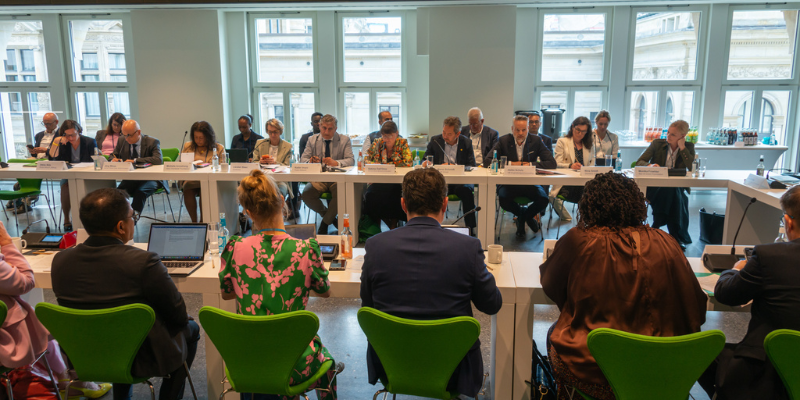
Right after the opening ceremony, where German President Frank-Walter Steinmeier called for stronger and more effective multilateral cooperation, and Mo Ibrahim highlighted the need for a fairer international financial system that better supports Africa’s economic potential. The BKMF joined a high-level roundtable hosted by GIZ and the World Resources Institute (WRI) on the future of jobs and skills in the green economy. CEO Monika Froehler highlighted the growing impact of climate change on agricultural jobs while underscoring the opportunities it presents. She emphasized that investing in upskilling and training can empower smallholder farming communities to adapt to a changing climate and benefit from emerging agricultural innovations from institutions such as CGIAR. The roundtable marked the launch of the report Jobs and Skills for the New Economy, with the discussion highlighting the significant economic opportunities presented by a people-centred climate transition, emphasizing that investments in skills development, workforce training, and inclusive financing are essential to creating resilient economies and ensuring that communities benefit from the transition to a low-carbon future.
On the same afternoon, the “Multi-Stakeholder Partnerships as a Catalyst of North-South Innovation” discussions led by CGIAR’s Executive Managing Director, Ismahane Elouafi, outlined the difficulties facing agricultural adaptation projects aimed at improving climate resilience and food security. These projects encompass some of the world’s most vulnerable communities, representing valuable and necessary initiatives. However, projects in this area struggle to generate high enough returns for private investors to get involved.
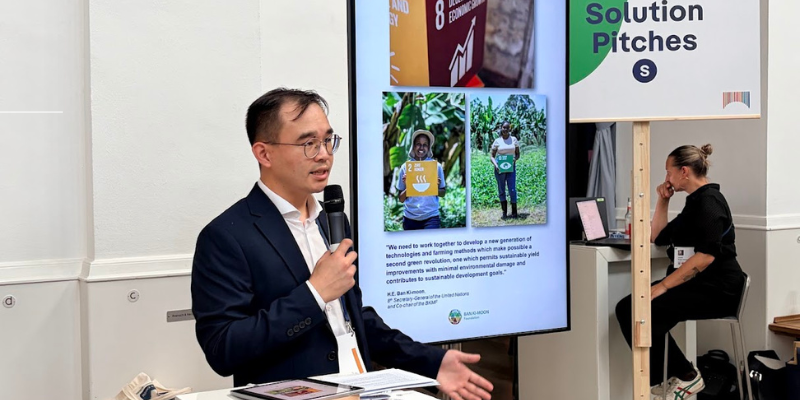
CEO Monika Froehler and Project Associate Timothy Sung also presented “Powering Smallholder Resilience with Data-Driven Agricultural Finance” at the conference’s Solution Pitches. The presentation featured the Foundation’s Elevating Agricultural Adaptation Programme and its Youth AgriChampions initiative, showcasing Farmslate, an innovative application developed by Nigerian Youth AgriChampion Ifeoluwa. By combining real-time farm data, geospatial technology, ecosystem health analysis, and local validation, the platform builds bankable risk profiles that connect smallholder farmers directly with financial institutions, enabling better-informed lending decisions while strengthening climate resilience and supporting sustainable agriculture.
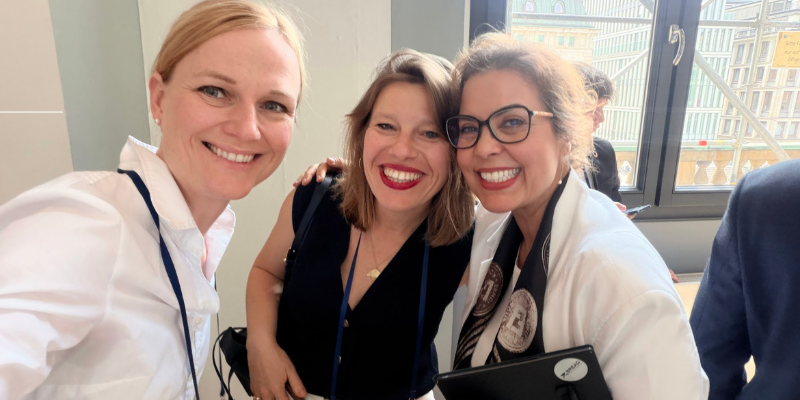
Throughout the conference, discussions reinforced the growing link between climate resilience and economic resilience, as well as launching the starting gun on debates about the Post-2030 Agenda. Participants highlighted the increasing risks posed by climate change, geopolitical instability, and disruptions to global supply chains, underscoring the urgent need to strengthen food security, invest in climate action, and ensure that the world continues to pursue a sustainable development pathway for the years to come. These themes were echoed during discussions on the EU Global Gateway, where State Secretary Niels Annen (BMZ) emphasized that European investment instruments must remain competitive and deliver tangible results, while the European Commission highlighted efforts to mobilize greater private investment through integrated financing packages and the new EU Investment Hub. CEO Monika Froehler had the opportunity to meet briefly with State Secretary Niels Annen (BMZ) and European Commission Deputy Director-General Marjeta Jager (DG INTPA) to exchange views on these priorities and the importance of accelerating effective partnerships and investment for sustainable development.
The conference also provided valuable opportunities to deepen partnerships and explore future collaboration. The BKMF engaged with leaders and experts from organisations including the World Food Programme, the UNDP, the European Commission, Welthungerhilfe, the UN SDG Action Campaign, the WRI, the German Federal Ministry for Economic Cooperation and Development, CGIAR, CEMUNE, Generation Unlimited, and the Education Commission, exchanging ideas on advancing sustainable development, climate resilience and agricultural innovation, and the global jobs and skills agenda.
This year’s HSC also provided a platform for the inauguration of the South-North Commission, offering an encouraging signal for the future of international cooperation. This new commission highlights the importance of building stronger partnerships between the Global South and North based on mutual collaboration rather than traditional donor-recipient relationships.
The HSC 2026 reinforced that today’s interconnected challenges, from climate adaptation and food security to workforce development and sustainable finance, cannot be solved in isolation. Through continued collaboration with governments, international organisations, the private sector, and local innovators, the Ban Ki-moon Foundation remains committed to advancing practical, inclusive solutions that create resilience, opportunity, and dignity for communities around the world.
Access our HSC 2026 Flickr album:

Access pictures from the High-Level Roundtable here: